

In this guide
How to read a Danish waste-bin label
Start with the written label and pictogram on the opening you are using. The Danish name tells you which waste category belongs there; the local instructions explain accepted items and how to prepare them.
A bin’s overall colour is not a reliable translation. Two grey containers may accept different materials, and one container can have separate compartments. Conversely, several labels beside one opening can describe materials collected together for later sorting.
Denmark uses shared waste pictograms and national sorting criteria, but collection arrangements vary locally. This guide explains the words you will encounter, with everyday examples rather than a promise that every product made from a material belongs in that bin.
You can look up individual items in the Mit Affald sorting guide or the Affaldsguide Danmark app. Both are available in Danish, English and Arabic.
Madaffald: food waste
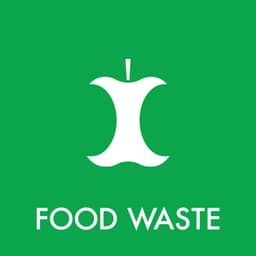
Mad means food, and affald means waste. Madaffald covers the food scraps accepted by your local collection, including many raw and cooked foods.
Examples include vegetable peelings, leftover bread, coffee grounds and eggshells. Copenhagen’s guide also includes cooked leftovers, small food residues such as sauce, and other specified organic items. Food waste is not restricted to vegetarian food or uncooked ingredients.
The important distinction is between food and everything around it. Empty food out of its packaging before sorting the two separately. A plastic tray does not become madaffald because it contains old food, and a product described as biodegradable is not automatically accepted.
Check the bag instructions separately. The correct material and collection method depend on the local scheme. Our food waste guide explains madaffald in more detail.
Restaffald: residual waste
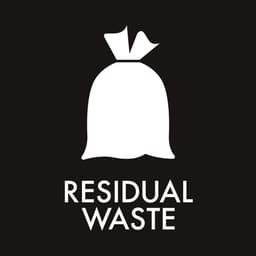
Restaffald means the waste left over after recyclable materials and items requiring special treatment have been separated. It does not mean “anything I cannot identify.”
Everyday examples can include cigarette ends and certain hygiene products, but follow the current local instructions for the particular item. Additional local collections can change where an item belongs.
Never use restaffald as a default for batteries, electronics or hazardous products. If an unfamiliar item looks electrical, contains a battery or has chemical contents, identify the appropriate collection route first.
You may also encounter rest as a shortened label. Read the full sign or provider’s guide if an abbreviation is unclear.
Papir: paper
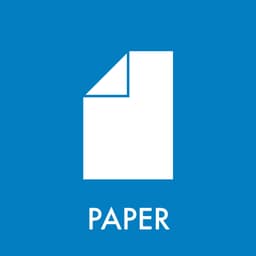
Papir is paper, such as newspapers, magazines, ordinary writing paper and envelopes accepted by the collection. Think of the material rather than whether something has words printed on it: a printed cardboard box is still cardboard.
Copenhagen lists newspapers, magazines, envelopes and printer paper in its paper collection. Its guidance distinguishes these from used kitchen roll and other unsuitable paper products.
Keep paper clean and dry. A paper-like product with a coating, food contamination or a different construction may need another route. Look up uncertain items rather than assuming that everything which tears like paper is suitable.
Pap: cardboard
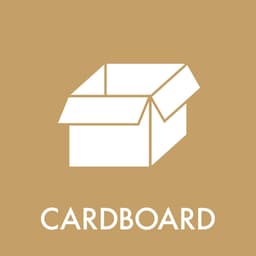
Pap means cardboard, including familiar boxes and cardboard packaging. It is a different word from papir, even if your local collection accepts both together.
Examples include delivery boxes, cereal boxes and cardboard tubes. Flatten boxes to make sensible use of the available space, following the collection’s instructions. Remove the contents and sort separate plastic wrapping or other packing material appropriately.
The confusing English word is “carton.” An ordinary cardboard cereal carton belongs to the cardboard category, while a milk or juice carton has its own category. The fact that both can be called cartons in English does not make their Danish labels interchangeable.
Mad- og drikkekartoner: food and drink cartons
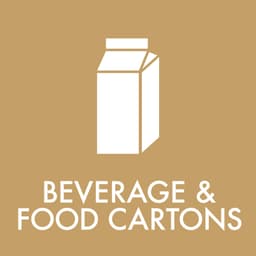
This means cartons used for food and drinks, including milk, juice and some soup or food cartons. Their layered construction distinguishes them from ordinary cardboard packaging.
You may see the name written with an ampersand, split across several lines or combined with plast. It still refers to the same category. In a combined plastic-and-carton collection, you use the designated opening for both accepted materials.
Do not interpret the label as every paper-based object that has touched food. Disposable paper cups and plates are not automatically food and drink cartons; Provas and other local guides list such items separately from this category.
Empty the carton before disposal. Follow the local instructions for preparation and lids rather than relying on the English word “carton” alone.
Glas: glass
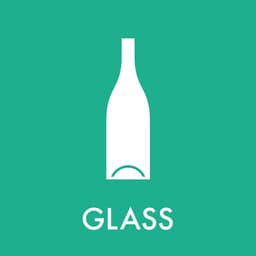
Glas commonly includes empty food jars and drink bottles without a refundable deposit. Clear and coloured packaging glass can both be accepted.
The label does not mean every transparent or brittle object. Ceramics, porcelain, mirrors, window glass, heat-resistant dishes and light bulbs need a separate check. Copenhagen’s glass guide specifically distinguishes special glass types and other unsuitable items from its glass collection.
Ordinary drinking glasses are another reason to consult the local guide rather than using a blanket rule from another country. Some Danish collections accept them, but that does not mean mirrors or oven dishes belong with bottles.
Check for pant before putting a drink container into ordinary recycling. A refundable bottle has a return route that also lets you recover the deposit.
Metal: metal
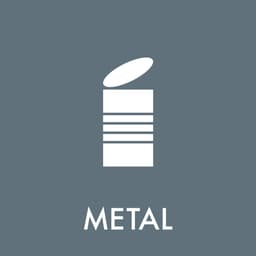
Metal is one of the more familiar labels for English speakers. Accepted items commonly include emptied food tins, metal lids, foil trays and small metal objects.
Copenhagen’s metal guide includes household items such as pots, pans and cutlery. Empty packaging as instructed before recycling it.
However, the material does not override a product’s function or contents. An electrical appliance needs an electronics route even if its casing is metal. Gas cylinders and packaging containing hazardous substances should not be treated as ordinary metal packaging.
A drinks can with a refundable deposit is another separate case: keep it for pant instead of immediately using the metal bin.
Plast: plastic
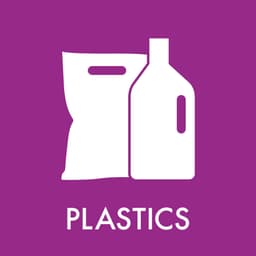
Plast means plastic. You may also see hård plast, meaning hard or rigid plastic, and blød plast, meaning soft or flexible plastic.
Examples include accepted food trays, plastic bottles without a deposit, bags and film. Copenhagen’s collection accepts both hard and soft plastic but excludes specified products such as PVC, biobags and certain mixed-material items.
A plastic-looking exterior is therefore not enough. An electric toothbrush is electronics, and packaging with chemical contents needs a product-specific check. “Compostable plastic” also does not automatically mean ordinary plastic recycling.
If the bin says plast together with mad- og drikkekartoner, follow that combined arrangement. Do not independently add another material just because you have seen it combined elsewhere.
Tekstilaffald: textile waste
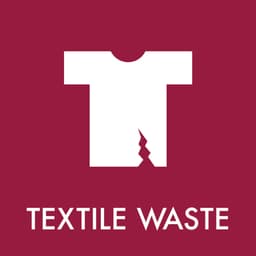
Tekstilaffald is suitable worn-out textile waste, not a general name for everything in your wardrobe. Examples include worn-out cotton clothing, towels and other accepted textiles that can no longer be used by someone else.
The Danish Environmental Protection Agency distinguishes textile waste from reusable clothes. Usable clothing should go to reuse; the textile-waste collection is not intended to replace that route.
Textile waste must be dry. Wet or mouldy material, chemical contamination and certain treated textiles are excluded. Shoes, belts and bags also need their own check rather than being added simply because they are worn on the body.
Follow the local bag and collection instructions, which can differ from those for clothes donated to charity.
Farligt affald: hazardous waste
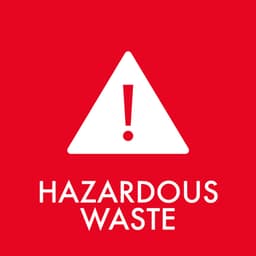
Farligt means dangerous or hazardous. This label identifies waste requiring special handling, including specified paints, chemicals and other products in the local guidance.
You might see a miljøboks, a dedicated collection box, or miljøskab, a collection cabinet. These names describe a collection facility, not permission to put every hazardous item inside it. Check the accepted contents, size limits and packaging requirements.
Do not mix chemical leftovers together to save space. If the product or container is unclear, ask the operator how it should be delivered rather than guessing from the bin colour.
Batterier and elektronik: batteries and electronics
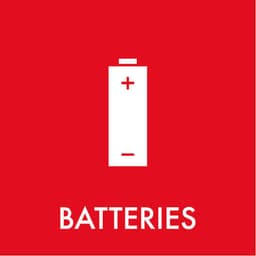
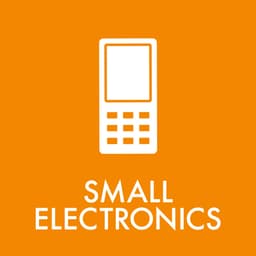
Batterier means batteries. Småt elektronik means small electronics; stort elektronik refers to larger electrical products. You may also see elektronikaffald, meaning electronic waste, and hvidevarer, meaning household appliances such as fridges and washing machines.
Used batteries must be collected separately, never in residual waste. The Environmental Protection Agency describes several local collection methods, so do not assume a particular bag-on-bin arrangement applies everywhere.
If you cannot safely remove a battery, do not force it out. The agency recommends getting help from the retailer or delivering the complete product as electronic waste. A small item still counts: chargers and battery-powered toys need the appropriate route too.
Collection words that are not material categories
Genbrugsplads and genbrugsstation mean recycling centre. Nærgenbrugsstation is a neighbourhood collection point, whose accepted items may be more limited. Genbrugsbutik is a second-hand shop, not another word for a waste container.
Genbrug means reuse: another person uses an item again. Genanvendelse means recycling its materials. Keeping a usable chair intact for a new owner is different from handing it over for material treatment.
Storskrald is bulky waste, while stort indbo refers to large household items in schemes using that name. Neither label guarantees collection of every large object. Check booking, placement and accepted items locally.
Pant means the refundable deposit on eligible drink containers. See our guide to returning bottles and cans for more detail.
Small instructions that make a big difference
- Ja tak / nej tak: accepted / not accepted.
- Tømt: emptied.
- Skrabet: scraped out.
- Rent og tørt: clean and dry.
- Løst: loose, rather than inside a closed collection bag.
- I pose: in a bag.
- Bind knude: tie a knot.
- Uden emballage: without packaging.
These instructions answer different questions. For example, “tømt” concerns the contents, while “løst” concerns how you put the item into the bin. Emptied packaging does not necessarily need washing: Copenhagen’s guidance says accepted plastic, metal, glass and food cartons should be emptied as well as possible without requiring rinsing.
If the name still leaves you unsure, search for the item and choose your municipality. For help getting started at a new address, read our newcomers’ guide to waste sorting. Follow the current local instructions whenever a general example differs from your collection scheme.
Sources and fact checking
Sources checked .
- Danish Environmental Protection Agency: National waste pictograms and sorting criteria
- Danish Environmental Protection Agency: Household sorting guidance
- City of Copenhagen: Food waste
- City of Copenhagen: Paper
- City of Copenhagen: Cardboard
- City of Copenhagen: Glass
- City of Copenhagen: Metal
- City of Copenhagen: Plastic
- City of Copenhagen: How clean should waste be?
- Provas: Sorting at home
- Danish Environmental Protection Agency: Sorting textiles
- Danish Environmental Protection Agency: Batteries
- Kredsløb: Waste and recycling in English
- Dansk Retursystem: About deposits
Mit Affald is an independent guide. Always follow your municipality’s current official instructions.
Found a mistake?
Tell us what needs correcting. Please include an official source if possible. info@simplecode.dk